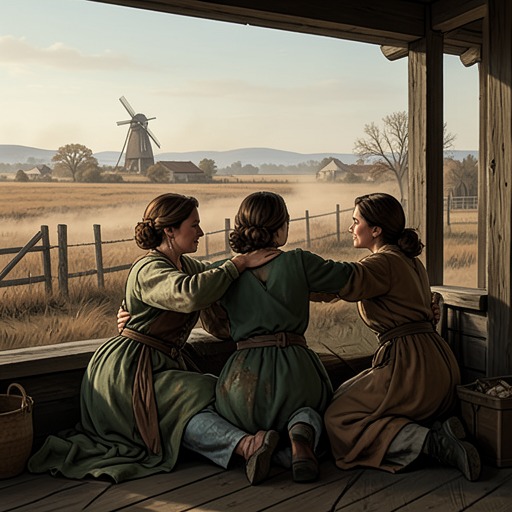
Belonging and finding home
It Must Be Love: A Mustang Prairie RomanceBelonging and finding home is one of the story’s decisive organizing ideas. For Trixie Beaumont, home begins as a place she has lost, becomes a life she must deliberately construct, and finally expands into a network of people who recognize her and whom she is willing to recognize in return. The concept also reaches into Jonquil Spring’s attempt to leave the commune and acquire ordinary social experience, Jack Thorpe’s uneasy household after Marissa Thorpe’s death, and Mustang Prairie’s ability to absorb outsiders without erasing their difficult pasts.
From Exile to Return
Trixie’s relationship with home is shaped by repeated departures. She remembers missing Mustang Prairie intensely while living elsewhere, yet she also learned from that separation. Her time away gave her distance from the town and from the body-image pressures she associated with popular culture; it also taught her that she could fit in neither there nor in the place she had left. The resulting insight is not that one location will automatically cure alienation, but that she needs a life of her own choosing.
That choice separates Trixie’s idea of home from the polished performance demanded by her marriage to Preston. During that marriage, she spent too much time shopping and maintaining her hair, nails, body, and public appearance in order to sustain the image of a perfect couple. She rejects that standard when she leaves the marriage, the city, and the identity built around perfection. The new life is explicitly not perfect, but it is right for her because it belongs to her rather than to an imposed picture of domestic success.
Her return to Mustang Prairie initially leaves her feeling like a visitor, a permanent tourist in a town she had loved and idealized. The shift occurs through participation rather than sentiment alone. At the Mustang Prairie Community Center, she greets people offering costume-making skills, supplies, food, and drinks, while coordinating stations, materials, and completed costumes. Seeing the town contribute to a shared undertaking allows her to recognize that she is no longer merely passing through. Community work turns remembered geography into lived belonging.
Building a Home Through Work
Trixie’s entrepreneurship gives belonging a material structure. For months she has considered creating her own clothing line, tested possible names, sketched logo ideas, and contacted a graphic designer. Those preparations make the dream tangible, but they also expose the cost of delay: the logos begin to taunt her because the imagined future remains inactive. Her decision to approach Mustang Prairie City Hall in a red polka-dot dress and red heels marks a practical threshold. She is no longer only dreaming of a business; she is seeking the approval needed to make it real.
The resulting concept, Sexy Separates by Trixie, expresses both commercial intelligence and personal philosophy. Trixie imagines six to ten panty styles, ranging from g-strings to bikinis and French cuts, in silk, lace, and cotton, with a possible boy-cut option. She also plans four bra styles, including a convertible bra, so customers can combine pieces rather than purchase a single prescribed set. A rainbow palette accommodates vibrant colors, while the example of Sadie’s deliberate mismatching confirms that women may value combinations of their own choosing over conventional matching.
This business is also a claim to stability. Under the Skirt Online is officially open, and several consecutive months of profit make expansion imaginable: the neighboring space could become both a warehouse and a workspace, with a part-time employee possible sooner than expected. Yet Trixie refuses to confuse optimism with security. She treats the line as her livelihood, career, and stability, and therefore insists on maintaining control over quality while the brand is new. When Jonquil Spring suggests reconsidering a manufacturer after helping rank seamstresses, Trixie explains that she will retain control until the brand is solid. Home, in this sense, is built through disciplined labor as much as through emotional attachment.
The launch of Sexy Separates by Trixie completes another stage of that construction. At Dylan’s bar, a makeshift runway divides the room, Sadie and the other models present Trixie’s designs, and songs by Sadie and Kiki Ramirez supply the soundtrack. Teal boy shorts, a matching Basque, a white cheeky set, a bra, a silky duster with silver buttons, and cherry-red stilettos transform the bar into a playful, intimate space. The applause and congratulations confirm the line’s public arrival. Trixie has created a professional identity inside the community, even though the success also reveals an emotional absence: she has accomplished the launch without anyone she can fully call her own person to share it with.
Family, Memory, and Chosen Inclusion
The idea of home becomes especially complicated around Jack Thorpe’s daughters. Abby Thorpe has spent nearly a month refusing ordinary conversation with her father, while still communicating basic needs in a cool, detached manner that reminds Jack of Marissa. Jack recognizes that Abby is miserable and believes he has the power to repair the situation, but his attempt to control where she spends time only deepens the distance. He tells her that a shop filled with sexy lingerie is no place for a girl her age, and she responds by pushing away from the table, gathering her books, and stomping upstairs.
Trixie offers Abby a different kind of adult attention. After Abby finds a photograph in the basement and asks for a hat like her mother’s, she admits that Jack will not let her come to the store and that she is unsure whether she can complete the project alone. Trixie promises to work it out, while still telling Abby to clear the arrangement with her father. The lesson is significant because Trixie does not simply replace parental authority; she provides practical help within a boundary that respects it.
The hat also makes belonging an act of memory. Trixie helps Abby finish it, adds pom-poms, and photographs Abby and Andie Thorpe on the porch. In the photograph, she notices Marissa’s face in the older image Abby has found, and the completed hat becomes a bridge between mother and daughter rather than an attempt to erase the dead. Abby later tells Jack that Trixie gives them good memories of their mother. Trixie is therefore admitted into the family not by displacing Marissa, but by helping the girls preserve and live with their memories of her.
Jack’s household is likewise being rebuilt after Marissa’s death. Thanksgiving brings a full house for the first time since the girls were babies: Jack’s parents remain in town, Sadie and Dylan arrive with side dishes, Luna brings a ham while holding Mr. Scanlan’s hand, and Jonquil Spring comes early with Abby and Andie to learn the household’s traditions. Trixie arrives only ten minutes before dinner, claiming to have lost track of time, and Jack understands her lateness as an effort to avoid him. The gathering thus contains both the warmth of an expanding family and the strain of a relationship whose emotional boundaries remain unsettled.
Jonquil Spring and the Right to Start Again
Jonquil Spring’s arrival at Trixie’s table gives the concept a second, more explicit form. Jonquil says that she needed to leave because she did not fit in the commune anymore and wanted, in her words, normal socialization skills. Her problem is not merely geographic departure. Having left at sixteen, she had to face first love, a first sexual encounter, heartbreak, contracts, grocery shopping, and other ordinary experiences without preparation. She has succeeded more than the average person despite that unusual upbringing, but success has not removed the loneliness or uncertainty produced by growing up outside ordinary social structures.
Trixie responds with protectiveness she did not know she possessed. She is unsure what she can offer while still arranging her own life, yet she understands the value of guidance because she remembers facing her own firsts without anyone to explain the cattiness of girls, the manipulative focus of boys, or the indifference of adults. Her relationship with Jonquil therefore makes home a developmental space: not a place where mistakes disappear, but a place where someone can encounter them with more support than Trixie herself had.
That support becomes practical when Jonquil works with Trixie in the workshop. Jonquil helps evaluate seamstresses and argues that some candidates are unsuitable, even suggesting a manufacturer. Trixie listens but keeps control of production because the new line requires dependable quality. Their shared work creates a sisterly bond without dissolving their differences. Jonquil can challenge Trixie’s decisions, and Trixie can remain responsible for the final choice while still allowing Jonquil a meaningful role in the life she is trying to build.
Home as an Imperfect Network
Trixie and Jack arrive at a shared language for belonging when they speak about leaving places that could not sustain the lives they needed. Trixie recalls the beauty and difficulty of her time away, while Jack explains that after Marissa’s death he tried for a year to preserve the city life he and Marissa had built for the girls, only to realize that continuing the hated parts of that life made him more miserable. Both characters discover that loyalty to an old arrangement can become another form of displacement. Finding home requires distinguishing memory from obligation.
Their exchange culminates in a toast to finding where they belong. The phrase joins romantic possibility to a broader search for identity, but it does not resolve their relationship. Jack’s attraction remains powerful, while Trixie continues to guard herself against loving someone who has not offered emotional certainty. Her retreat after Thanksgiving and her refusal to spend unnecessary time with him show that belonging cannot mean surrendering self-protection. A home that depends on another person’s indecision would reproduce the instability she has worked to escape.
The Christmas sequence complicates that resistance through objects and gestures. Trixie buys Jack a gift despite insisting to herself that she is doing so as a friend, while Jack gives her the original of Blue Skies, her favorite painting. The painting cannot magically settle their relationship; instead, it makes her love harder to deny and harder to overcome. At the same time, Andie tells Jack to apologize to Trixie, and the girls explain that they like her because she makes them pretty things, speaks to them as capable older children rather than babies, and gives Abby meaningful memories of Marissa. Their testimony shows how belonging is recognized from within a family: through repeated acts of attention, not merely through romantic declarations.
The concept finally resists the fantasy of a perfect destination. Trixie’s chosen life contains financial risk, unresolved desire, painful memory, and the continuing possibility of disappointment. It nevertheless offers work she controls, relationships that have become a kind of family, and a town in which her participation matters. Belonging and finding home therefore describes an ongoing practice rather than a completed arrival: leaving false versions of perfection, making useful things, accepting help, preserving the dead without living entirely among ghosts, and allowing chosen community to become more substantial than inherited instability.